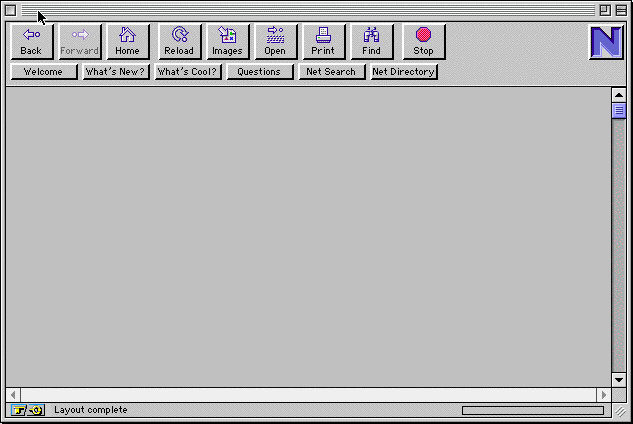
Netscape Navigator 0.9b was released June 13, 1994. It was the first widely-used web browser, growing out of NCSA Mosaic, an earlier software which could combine both text *and* images on the same webpage. And yet Netscape 0.9b (b is for beta) was not even version 1.0 — this pre-release was a sign of the hyperspeed of browser software development. You can test-drive an emulator here.
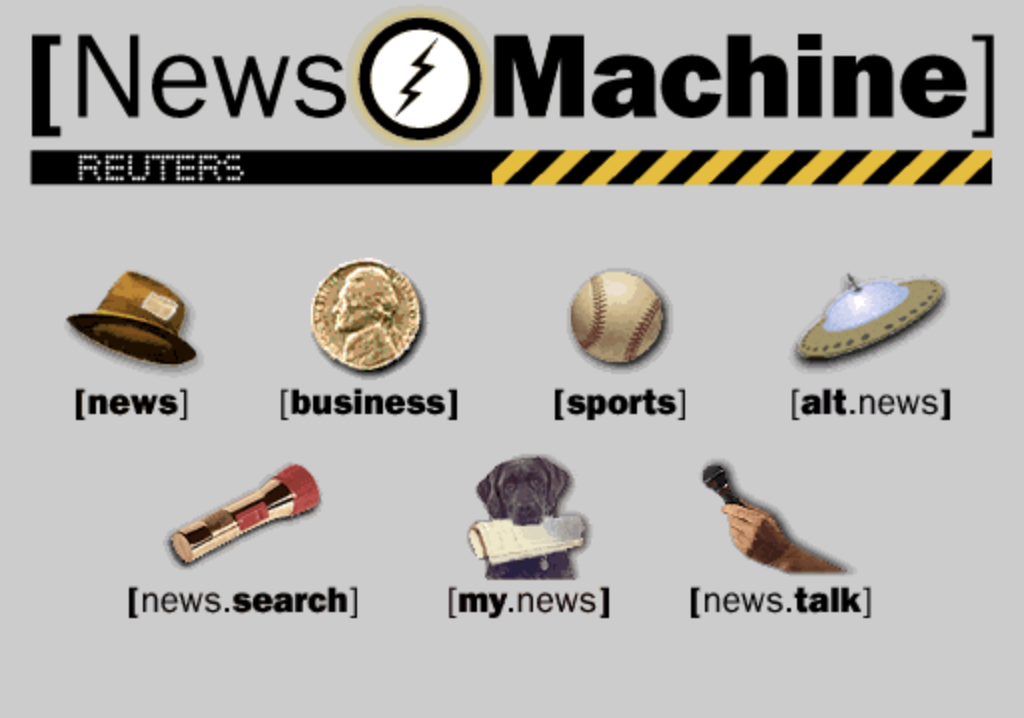
I remember Netscape 0.9b well. I was working for Two Twelve Associates in New York (see Sylvia Harris from last class) as a young, rather green junior designer. Two Twelve had worked on a series of early screen-based projects when Reuters approached with a new project. Founded in 1851 and based in London, Reuters was one of the world’s largest news providers. By 1994, Reuters was ready to reach a new audience through a consumer-facing website they called the Reuters News Machine. Being eager, and technically-minded, I convinced the studio that I could do this project. I found a contract programmer, Stuart Constantine of the early design blog CORE77, to produce a small, static website to deliver real-time news stories. Here is what the homepage looked like, all 150k of it:
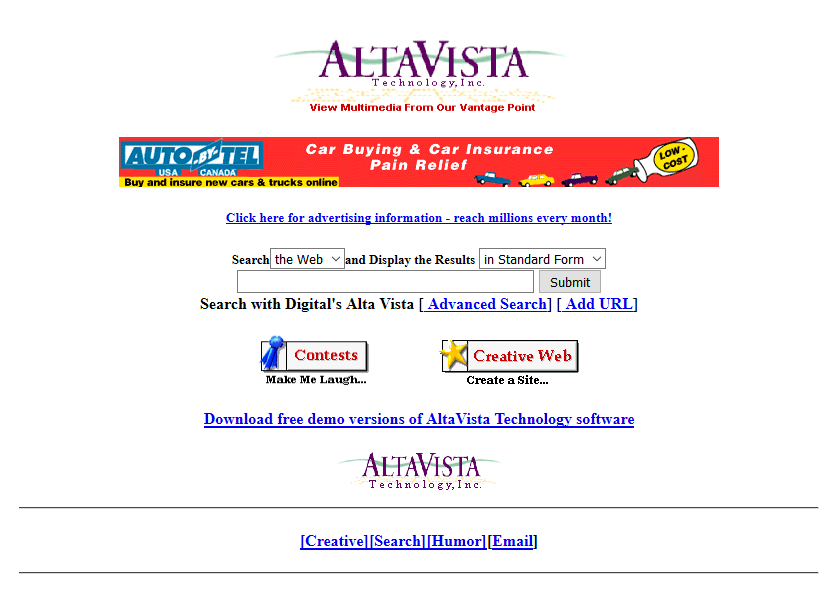
This was all brand new. News on the web really didn’t exist yet. Internet directories like Yahoo which pointed to other websites as a list organized by topic. Primitive search had just arrived with Altavista. The New York Times first website appeared two years later. With its multi-media browser and the flood of new, content-rich websites, Netscape absolutely took off. It quickly become the dominant web browser with 75% market share after four months while releasing update after update, adding an email reader, page composer, even its own browser scripting language, Javascript.
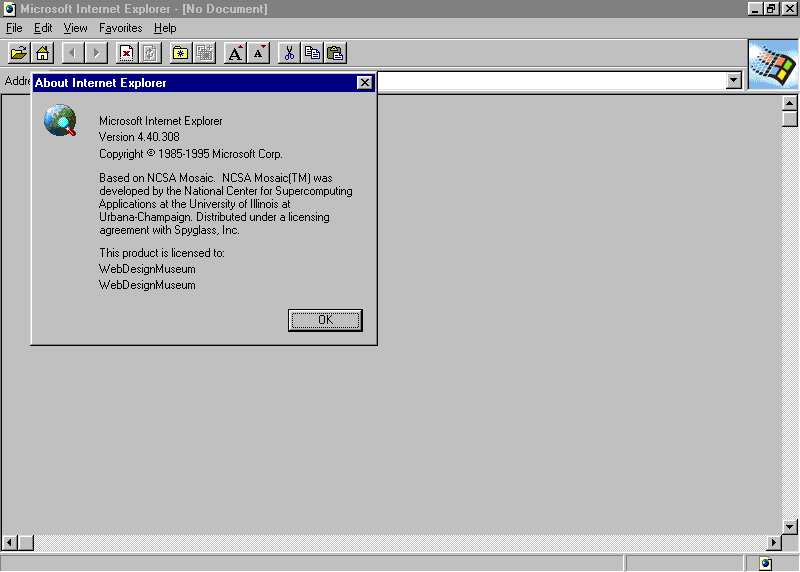
By late 1995 and realizing they were missing the wave, Microsoft quickly licensed Mosaic’s software and released their own browser, Internet Explorer. IE v1.0 was an inferior product, but it was also free for all users while Netscape was free for individuals but not for companies. Microsoft *poured* money into its new product and Internet Explorer rapidly improved. By 1997, a much-improved v4.0 was released in San Francisco with a 10-ft tall “e” logo. That night, Microsoft employees hired a moving crew to drive the logo down to Mountain View and quietly install it on Netscape’s front lawn. Netscape employees witnessed the maneuver and countered by knocking it to the ground and installing their own mascot on top.
The Browser Wars were on, as Microsoft and Netscape aggressively competed for users with updates and custom features. At the time, Microsoft Windows had a near monopoly on operating system software for personal computers (around 95%). Microsoft bundled IE with Windows as its default browser, tightly integrating the browser into the operating system and, as a result, users often did not even realize they had a choice. (Microsoft was later sued for this anti-competitive behavior.) Microsoft was trying to ”cut off Netscape’s air supply.” It worked. By 1999 Microsoft owned 99% of the browser market.
Realizing that a browser monopoly web was not in the best interest of users or the web, Netscape open-sourced its code, established a non-profit (Mozilla Foundation), and launched what would become the Firefox browser in 2002.
The wars were over, for now.
Continues in class ...


I remember Netscape 0.9b well. I was working for Two Twelve Associates in New York (see Sylvia Harris from last class) as a young, rather green junior designer. Two Twelve had worked on a series of early screen-based projects when Reuters approached with a new project. Founded in 1851 and based in London, Reuters was one of the world’s largest news providers. By 1994, Reuters was ready to reach a new audience through a consumer-facing website they called the Reuters News Machine. Being eager, and technically-minded, I convinced the studio that I could do this project. I found a contract programmer, Stuart Constantine of the early design blog CORE77, to produce a small, static website to deliver real-time news stories. Here is what the homepage looked like, all 150k of it:
This was all brand new. News on the web really didn’t exist yet. Internet directories like Yahoo which pointed to other websites as a list organized by topic. Primitive search had just arrived with Altavista. The New York Times first website appeared two years later. With its multi-media browser and the flood of new, content-rich websites, Netscape absolutely took off. It quickly become the dominant web browser with 75% market share after four months while releasing update after update, adding an email reader, page composer, even its own browser scripting language, Javascript.
By late 1995 and realizing they were missing the wave, Microsoft quickly licensed Mosaic’s software and released their own browser, Internet Explorer. IE v1.0 was an inferior product, but it was also free for all users while Netscape was free for individuals but not for companies. Microsoft *poured* money into its new product and Internet Explorer rapidly improved. By 1997, a much-improved v4.0 was released in San Francisco with a 10-ft tall “e” logo. That night, Microsoft employees hired a moving crew to drive the logo down to Mountain View and quietly install it on Netscape’s front lawn. Netscape employees witnessed the maneuver and countered by knocking it to the ground and installing their own mascot on top.

The Browser Wars were on, as Microsoft and Netscape aggressively competed for users with updates and custom features. At the time, Microsoft Windows had a near monopoly on operating system software for personal computers (around 95%). Microsoft bundled IE with Windows as its default browser, tightly integrating the browser into the operating system and, as a result, users often did not even realize they had a choice. (Microsoft was later sued for this anti-competitive behavior.) Microsoft was trying to ”cut off Netscape’s air supply.” It worked. By 1999 Microsoft owned 99% of the browser market.

Realizing that a browser monopoly web was not in the best interest of users or the web, Netscape open-sourced its code, established a non-profit (Mozilla Foundation), and launched what would become the Firefox browser in 2002.
The wars were over, for now.
Continues in class ...
March 16, 2026
Netscape Navigator 0.9b
Reading
W3 Schools Javascript Tutorial
my website is a shifting house next to a river of knowledge. what could yours be? (Laurel Schwulst)
Resources
Reuters NewsMachine
Reuters Corporate
Netscape Navigator 0.9b (emulator)
The Interface Experience
The Browser Wars
Tales from the Browser Wars
The Birth of Javascript
Assignment
#2 <img> (ends)
#3 w-w-w (starts)
Visitor
Laurel Schwulst (via Landline (kinda))
Netscape Navigator 0.9b
Reading
W3 Schools Javascript Tutorial
my website is a shifting house next to a river of knowledge. what could yours be? (Laurel Schwulst)
Resources
Reuters NewsMachine
Reuters Corporate
Netscape Navigator 0.9b (emulator)
The Interface Experience
The Browser Wars
Tales from the Browser Wars
The Birth of Javascript
Assignment
#2 <img> (ends)
#3 w-w-w (starts)
Visitor
Laurel Schwulst (via Landline (kinda))