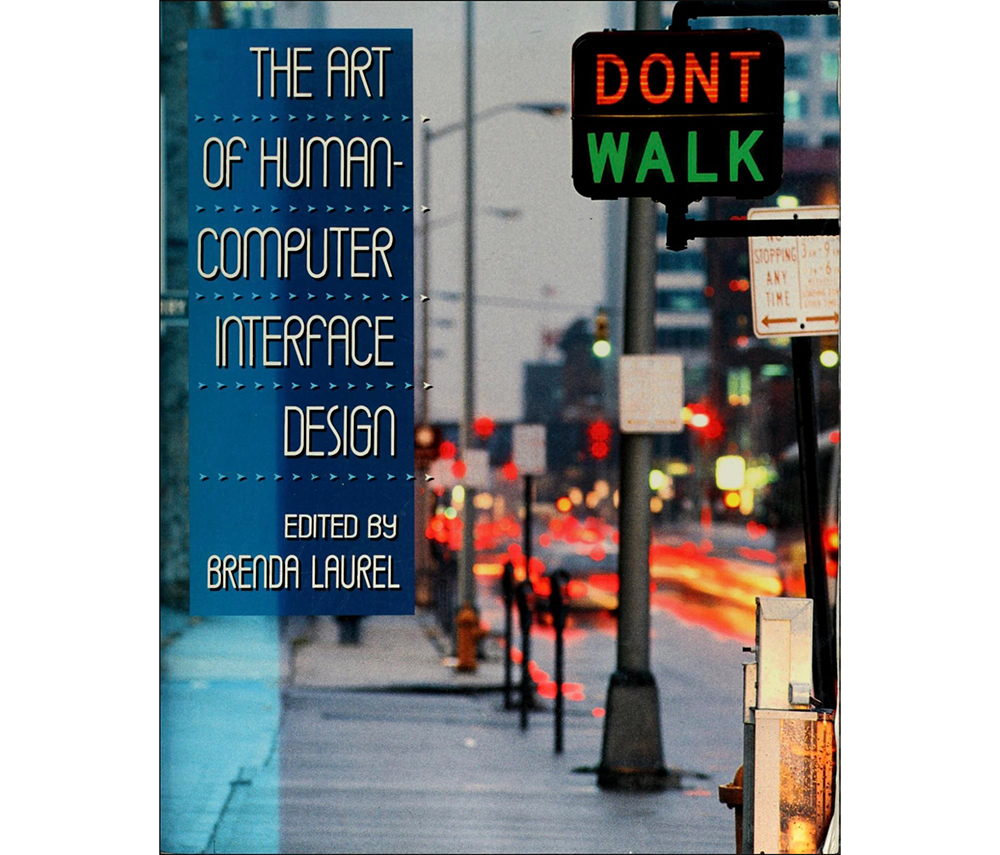
Published in 1990, The Art of Human-Computer Interface Design became a bit of a Bible for a discipline trying to define itself.
But it didn’t start out that way. Apple Human Interface Group manager Joy Mountford writes in the book’s introduction:
There were already pockets where the two approaches were being synthesized. One was Apple’s Advanced Technology Group, a collection of free-thinking engineers and designers exploring new software projects whose scope and/or timeframe were outside of more commercially-driven parts of Apple. It was a center for research, inspiring and inspirational. Reporting on it twenty years later, Fast Company called ATG “legendary.”

Probably true enough if you look around at the software it produced over its 11-year lifespan from 1986 – 1997. A partial list includes QuickDraw, QuickTime, QuickTime VR, ColorSync, AppleScript, PlainTalk speech recognition, Speech Synthesis, Apple Data Detectors, and HyperCard.
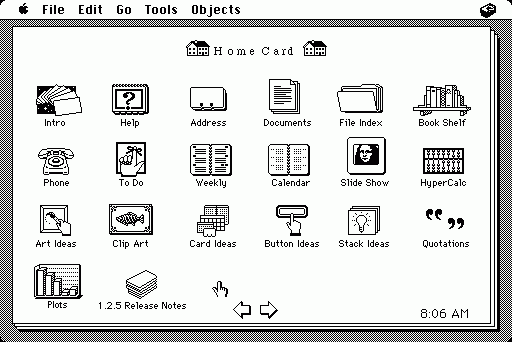
HyperCard, organized around the metaphor of a stack of linked cards, allowed non-programmers to assemble interactive softwares that would run on Apple Macintosh. Any individual card could contain text, images (even rudimentary audio and video) plus any number of buttons or hyperlinks which connected one card to another card in the stack. HyperCard found a rabid audience for its hypertextural logic and inspired Tim Berners-Lee (from class 1) and his WorldWideWeb. (Fun fact: Apple programmer Bill Atkinson was inspired himself originally to make HyperCard following an LSD trip.)
For The Art of Human-Computer Interface Design, Advanced Technology Group member Laurie Vertelney posed a time-constrained interface design exercise to both a computer programmer, Henry Lieberman from MIT Visible Language Workshop, and to an Apple interface designer, Michael Arent. The two approaches are rather different. We will have a look.
Continues in class ...
But it didn’t start out that way. Apple Human Interface Group manager Joy Mountford writes in the book’s introduction:
The initial idea was to collect some of the distributed expertise and wisdom about interfaces inside Apple into a book that could be used to train current and future Apple employees.Interface design was still brand new and handled by either computer programmers (concerned mostly with functionality) or graphic designers (focused on communication and consistency). Even within Apple, there were committed positions on either side. Editor Brenda Laurel described the situation: “The noun, interface, is taken to be a discrete and tangible thing that we can map, draw, design, implement, and attach to an existing bundle of functions.” She goes on to describe that the book was meant to “explode that notion and replace it with one that can guide our work in the right direction.”
There were already pockets where the two approaches were being synthesized. One was Apple’s Advanced Technology Group, a collection of free-thinking engineers and designers exploring new software projects whose scope and/or timeframe were outside of more commercially-driven parts of Apple. It was a center for research, inspiring and inspirational. Reporting on it twenty years later, Fast Company called ATG “legendary.”
Probably true enough if you look around at the software it produced over its 11-year lifespan from 1986 – 1997. A partial list includes QuickDraw, QuickTime, QuickTime VR, ColorSync, AppleScript, PlainTalk speech recognition, Speech Synthesis, Apple Data Detectors, and HyperCard.
HyperCard, organized around the metaphor of a stack of linked cards, allowed non-programmers to assemble interactive softwares that would run on Apple Macintosh. Any individual card could contain text, images (even rudimentary audio and video) plus any number of buttons or hyperlinks which connected one card to another card in the stack. HyperCard found a rabid audience for its hypertextural logic and inspired Tim Berners-Lee (from class 1) and his WorldWideWeb. (Fun fact: Apple programmer Bill Atkinson was inspired himself originally to make HyperCard following an LSD trip.)
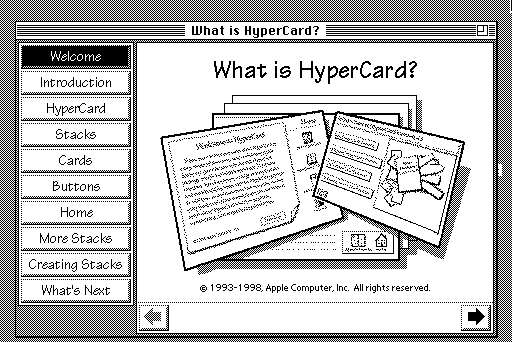
For The Art of Human-Computer Interface Design, Advanced Technology Group member Laurie Vertelney posed a time-constrained interface design exercise to both a computer programmer, Henry Lieberman from MIT Visible Language Workshop, and to an Apple interface designer, Michael Arent. The two approaches are rather different. We will have a look.
Continues in class ...
February 16, 2026
The Art of Human-Computer Interface Design
Reading
The Art of Human-Computer Interface Design (Brenda Laurel, ed)
Resources
Apple Advanced Technology Group
The legendary Apple research group that shaped our world
HyperCard, the missing link to the Web
1986-12-Human-Interface-Guidelines-(Final-Draft)
Assignment
#1 <a> (continues)
The Art of Human-Computer Interface Design
Reading
The Art of Human-Computer Interface Design (Brenda Laurel, ed)
Resources
Apple Advanced Technology Group
The legendary Apple research group that shaped our world
HyperCard, the missing link to the Web
1986-12-Human-Interface-Guidelines-(Final-Draft)
Assignment
#1 <a> (continues)